Quick Math — How to Play
Solve arithmetic questions accurately before worrying about speed.
See the game before you play
These screenshots show the actual BrainBaazi game, not illustrations or AI-generated mockups. The interface may change as the game is updated.
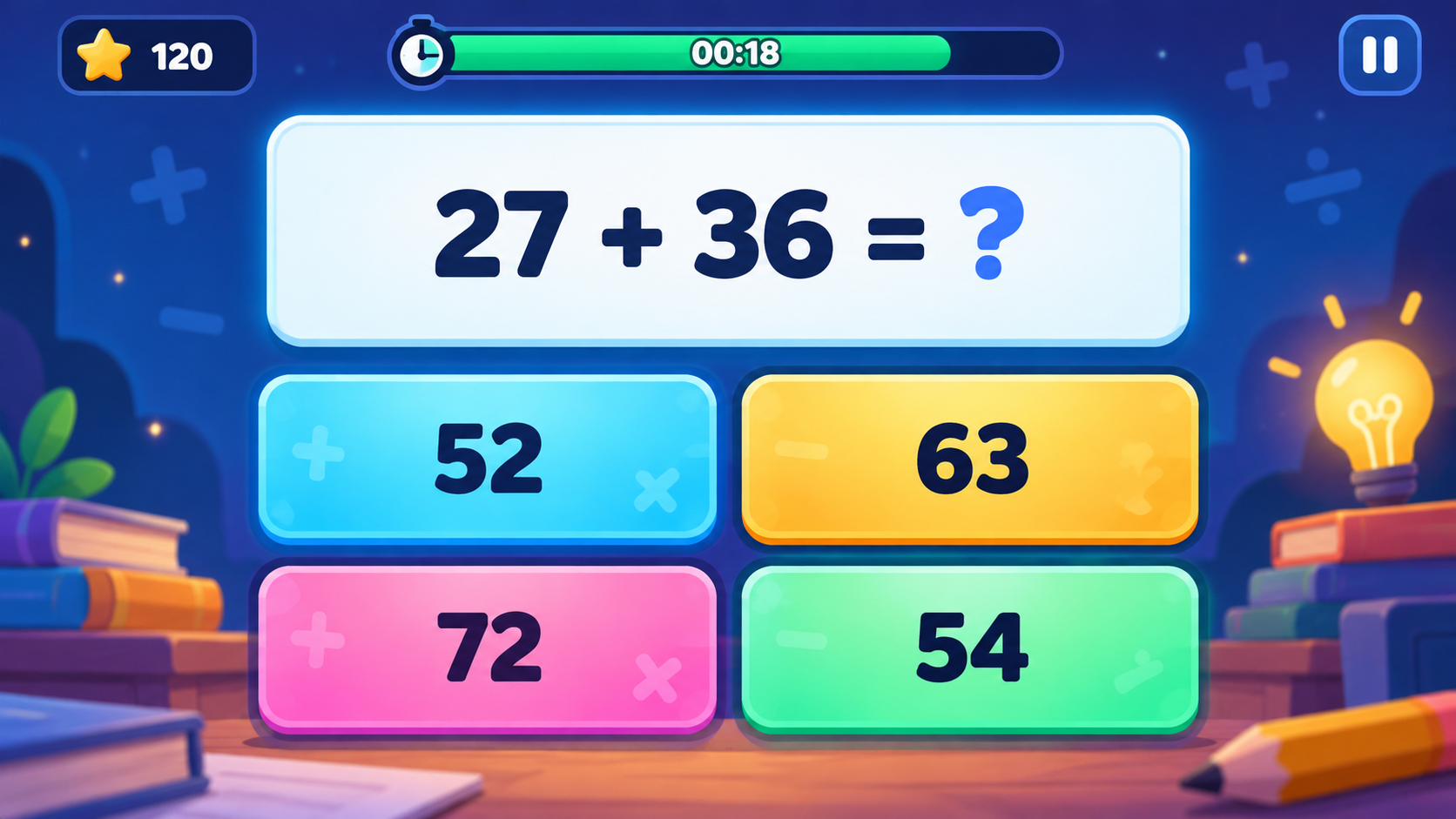
Approach the challenge
Read the entire expression, do multiplication before addition when relevant, and check signs before submitting.
Worked example
For 18 + 7, add 2 to reach 20, then add the remaining 5 to get 25.
Common mistake to avoid
Rushing past a minus sign; guessing without checking the operation.
Practice idea
Try five warm-up questions, then repeat a round while tracking which operations slow you down.
A calculation worth slowing down for
Make the operation obvious
Before calculating, identify whether the question asks for addition, subtraction or multiplication. It sounds basic, but a wrong operation cannot be rescued by fast arithmetic. For 63 − 28, subtract 20 first (43), then 8 (35). If you subtract 30 instead, add 2 back to reach the same answer.
When the answer feels close
Estimate before choosing: 63 − 28 is a little above 30, so 35 makes sense; 55 does not. For 19 × 6, think 20 × 6 − 6 = 114. These are mental shortcuts, not rules the game requires.
A useful two-round experiment
In your first round, prioritise accuracy. In the next, try the same method at a steadier pace. Note whether it was reading the sign, remembering a multiplication fact or rushing the final tap that caused the mistakes.
Before you begin
Read the expression on screen and use the displayed answer controls. The currently loaded puzzle build determines the available choices and timer.
A practical first attempt
Try 48 − 19 without racing the clock. Subtract 20 to get 28, then add 1 back to reach 29. That correction is less work than borrowing digit by digit. When you are comfortable with the method, repeat it on a different subtraction problem.
When the clock makes a simple question feel hard
Start by recognising the type of arithmetic. With 7 × 8, recall 56 if you know it; with 19 × 6, working from 20 × 6 − 6 gives 114. Changing methods for each question wastes time, so pick one reliable shortcut for the kind of problem you see.
Build a short practice loop
Do five questions slowly and note whether mistakes came from reading, calculation or the final tap. Then do another five at ordinary speed. Tracking error types is more informative than simply declaring the second round better or worse.
A useful accuracy check
Estimate an answer range before committing. For 72 − 38, the result must be in the thirties, not in the sixties. Estimation will not replace calculating, but it catches some obvious misreads quickly.
Questions players ask
Do I have to answer as quickly as possible?
The round may reward or constrain speed, but building a reliable calculation method is a better starting point than random quick taps.
Why do I repeatedly miss subtraction?
Look for the step where borrowing or subtracting tens changes the number. Try the round-number-and-correct method on a few examples.
BrainBaazi puzzle collection. Guidance is editorial; the live game screen takes priority.
For more worked examples: Read the related BrainBaazi article →
A three-question rehearsal you can do away from the game
Try 39 + 26, 72 − 38 and 16 × 7 on paper or in your head. For the first, move 1 from 26 to 39: 40 + 25 = 65. For the second, subtract 40 then add 2: 34. For the third, 10 × 7 + 6 × 7 = 70 + 42 = 112. Each solution uses a different move; that is deliberate.
Now ask yourself which calculation required a correction after rounding. If you routinely forget to add the correction back, spend one short practice round on that exact habit. You can even say “subtract 40, return 2” before selecting an answer.
Finally, retry the same types with different values, such as 48 + 17, 91 − 49 and 13 × 8. Avoid memorising the earlier answers; you are practising the route. These are illustrative exercises, not a list of BrainBaazi level questions.
Visit the Quick Math play page for a separate in-game field guide and to launch the game.
Prefer a broader explanation? Read our game and puzzle articles, or return to the full game catalog.
Controls, levels and available features can vary by game version. Follow any current on-screen instructions.
Play Quick Math →