Number Sequence — How to Play
Identify the rule linking consecutive numbers and choose the missing value.
See the game before you play
These screenshots show the actual BrainBaazi game, not illustrations or AI-generated mockups. The interface may change as the game is updated.
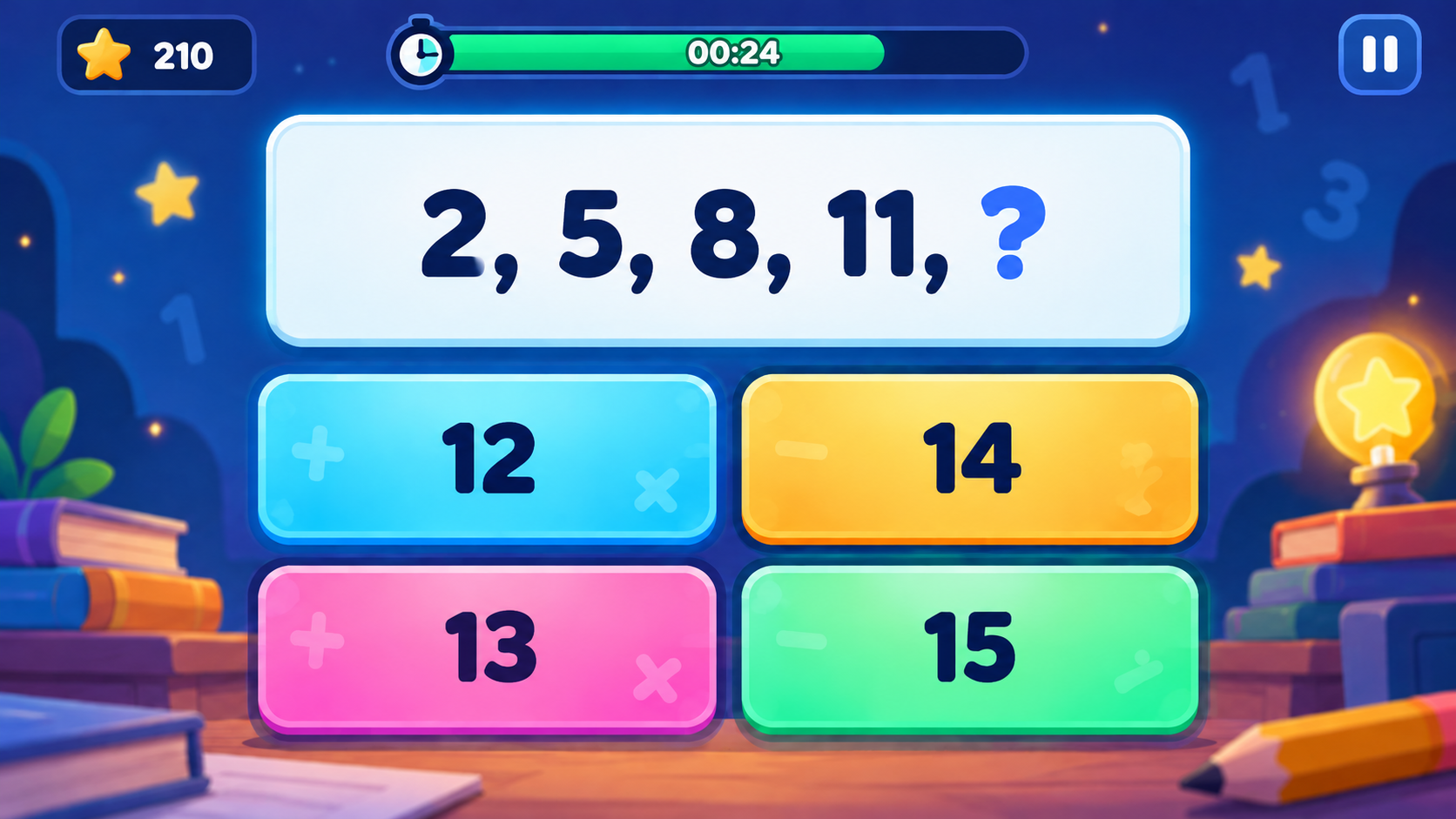
Approach the challenge
Calculate differences between neighbors first. If they change, test multiplication, alternating rules or increasing gaps.
Worked example
For 3, 6, 9, 12, the change is +3 each step, so the next value is 15.
Common mistake to avoid
Assuming every series has a constant gap; ignoring alternating terms.
Practice idea
Write down the first three differences before choosing an answer.
Do not commit to the first pattern you notice
Start with the gaps
For 4, 9, 14, 19, write +5, +5, +5. Now try 3, 6, 12, 24; the gaps change, but multiplying by 2 explains every step. A convincing rule must fit the whole series, not just the first pair.
Check every other position
For 2, 10, 4, 20, 6, 30, the odd-position numbers increase by 2 while the even-position numbers increase by 10. That is why checking only neighbouring gaps can mislead you.
Test your prediction
Before selecting, use your proposed rule to reconstruct an earlier number. If it fails halfway through, reconsider. This backward check is especially helpful when two possible answers look plausible.
Before you begin
Read the displayed sequence, infer its rule, then select the answer using the in-game choices. Available levels and answer formats follow the loaded puzzle build.
A practical first attempt
For 3, 7, 11, 15, the gaps are +4 each time, so 19 follows. Compare that with 2, 5, 9, 14: the gaps are +3, +4, +5, so the next step is +6 and the answer is 20. They look similar at a glance, but they are different tasks.
Why differences deserve the first look
Differences compress a long line of numbers into smaller moves. With 21, 18, 15, 12, a repeated −3 appears immediately. When gaps move from +2 to +4 to +6, an increasing-step hypothesis becomes more useful than a constant addition rule.
Try two tracks for alternating patterns
Take 2, 10, 4, 20, 6, 30. The first, third and fifth terms are 2, 4, 6. The second, fourth and sixth are 10, 20, 30. Looking only at neighbouring terms hides this simple structure.
Double-check before the answer
Use the rule to reproduce an earlier step. If you claim repeated doubling for 3, 6, 12, 24, both 6→12 and 12→24 should work. A pattern that fails half the evidence is not ready to use.
Questions players ask
Can more than one pattern fit?
Sometimes yes, especially with few terms. Prefer the simplest rule that consistently fits all the visible numbers and any answer options.
What if the gaps keep changing?
Check whether the gaps themselves follow a pattern, then test odd and even positions separately.
BrainBaazi puzzle collection. Guidance is editorial; the live game screen takes priority.
For more worked examples: Read the related BrainBaazi article →
Work through two look-alike sequences
Write these side by side: A = 4, 9, 14, 19 and B = 4, 9, 15, 22. Sequence A has a fixed jump of 5, so its next value is 24. Sequence B grows by 5, 6 and 7, making the next jump 8 and the next value 30. A fast glance might make both look like “add five”.
Try one more: 3, 12, 6, 24, 9, 36. Odd positions are 3, 6, 9; even positions are 12, 24, 36. The example illustrates two tracks rather than one continuous gap. Say which terms belong together before predicting anything.
If two candidate rules seem possible, test each against the entire available line. Prefer a short explanation that can reproduce all the visible steps. These are practice examples created for this guide, not a promise that the same numbers appear in a specific level.
Visit the Number Sequence play page for a separate in-game field guide and to launch the game.
Prefer a broader explanation? Read our game and puzzle articles, or return to the full game catalog.
Controls, levels and available features can vary by game version. Follow any current on-screen instructions.
Play Number Sequence →